PIXNET Logo登入

阿可的窩 Yi-Juai

跳到主文

<陳怡睿醫師的部落格> 口腔疾病診察與醫療的溝通平台...

部落格全站分類:醫療保健

  • 相簿
  • 部落格
  • 留言
  • 名片
  • 10月 06 週一 200814:28
  • (新聞稿)如果口腔潰瘍超過二個星期沒有癒合~

過去許多人應該經常聽到牙醫師提醒民眾說「如果口腔潰瘍超過二個星期沒有癒合,就應該盡快找醫生,因為這可能是發生口腔癌的前兆!」其實還有許多其它的疾病也會表現出口腔潰瘍的症狀,包括皮膚粘膜疾病,如扁平苔癬、天疱瘡等,另外一種特殊病例就是口腔梅毒,提醒民眾也要小心防範!
最近一位30歲的男性患者至本院牙科門診部就診,主訴在他的下唇內側出現兩個潰瘍,且持續好幾個星期未見好轉,大小約有直徑1公分,潰瘍的表面有點凸出,呈現高原狀,上面則是覆蓋著灰白色的組織。另外在患者下頜兩側的頰繫帶處各有一個直徑大約0.5公分的潰瘍。此症狀與第二期梅毒臨床表現的潰瘍病灶有些類似。於是經過進一步詢問患者是否在身體其他的地方曾出現過類似的症狀,患者描述在2-3個月前,在他的外生殖器上有過類似的白色病灶,後來擦了藥後就消失了。最後經驗血結果,研判他感染了梅毒,因為梅毒是政府規定的法定傳染病之一,因此本病例立刻被轉診到本院的感染控制科去做治療,並依規定報告到衛生主管單位。
梅毒是一種以性接觸為傳染途徑的傳染病,由感染梅毒螺旋體所引起,大致上可以分成三期。第一期叫做軟疳(Chancre),在第一次感染病原菌後約三個星期出現,98%以上的病灶會出現在外生殖器及肛門,只有非常少數會出現在外生殖器及肛門以外的地方,而這些地方以嘴唇最為常見。第一期的梅毒通常在3-8個星期後會自己痊癒,但是如果患者沒有接受適當的治療,在第一次感染病原菌後約3個月左右,病原菌會進入血液,讓疾病進入第二期。
第二期梅毒的病情較不一定,患者有時的症狀是倦怠感、發燒、頭痛、聲音嘶啞、關節痛,此時患者最具傳染力。其中有30%的患者會出現口腔黏膜的潰瘍,稱為「黏膜斑」,這種黏膜斑具有很強的傳染力,如果患者這時持續的有性關係,包括口交的進行,就會很容易把疾病散播出去。若初期梅毒及中期梅毒未給予妥善治療,約3-12個月後病況就會進入晚期,晚期梅毒最明顯的特徵是出現單獨或多發性梅毒肉芽腫,出現的部位包括皮膚、皮下組織、黏膜層或內臟等,通常症狀會在初期感染後三至十二年內出現,呈現潰瘍現象不對稱,中心有痊癒現象,最後潰瘍會向四周蔓延。
(繼續閱讀...)
文章標籤

juaios 發表在 痞客邦 留言(0) 人氣(5,057)

  • 個人分類:新聞稿件
▲top
  • 10月 06 週一 200814:24
  • (20060927新聞稿)口腔黴菌久治不癒 赫然是感染愛滋病毒

口腔黴菌久治不癒 赫然是感染愛滋病毒
DWNEWS.COM-- 2006年9月27日11:56:0(京港台時間) --多維新聞


(繼續閱讀...)
文章標籤

juaios 發表在 痞客邦 留言(0) 人氣(498)

  • 個人分類:新聞稿件
▲top
  • 10月 06 週一 200814:18
  • (20070327新聞稿)口腔內出現不明斑塊別輕忽 小心癌前病變


口腔內出現不明斑塊別輕忽 小心癌前病變


中央社╱中央社 2007-03-27 15:46


(繼續閱讀...)
文章標籤

juaios 發表在 痞客邦 留言(0) 人氣(280)

  • 個人分類:新聞稿件
▲top
  • 10月 06 週一 200811:41
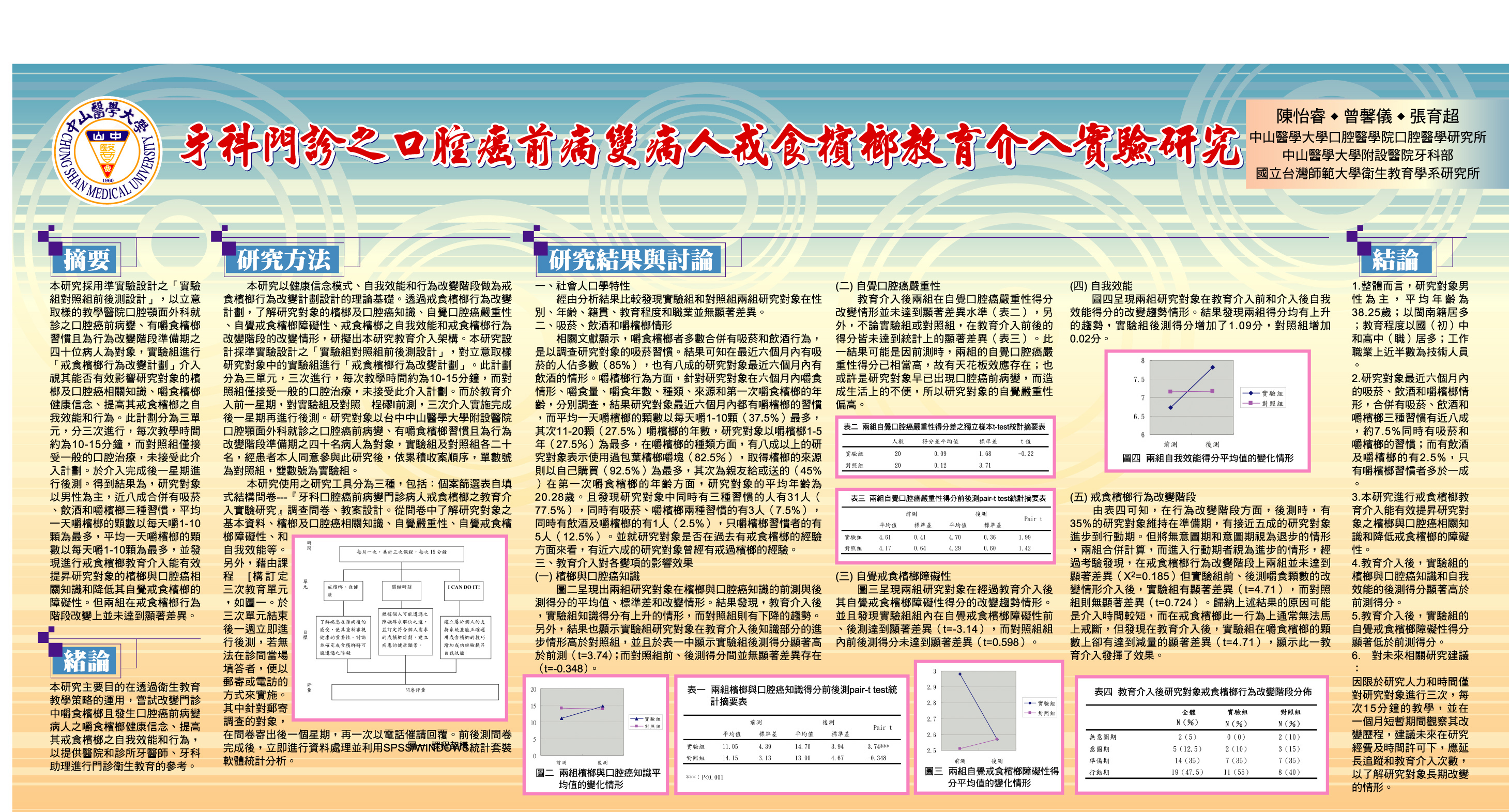
  • (2007家牙大會貼示報告)牙科門診之口腔癌前病變病人戒食檳榔教育介入實驗研究


(繼續閱讀...)
文章標籤

juaios 發表在 痞客邦 留言(0) 人氣(130)

  • 個人分類:學會報告
▲top
  • 10月 06 週一 200811:21
  • (2008口外大會貼示報告)Ameloblastoma with an unusual radiographic feature – a case report

Ameloblastoma with an unusual radiographic feature – a case report
Yi-Juai Chen* and Yu-Feng Huang
*Institute of Stomatology, Chung Shan Medical University, Taichung, Taiwan
Ameloblastoma is a rare, benign tumor of odontogenic epithelium much more commonly appearing in the mandible than the maxilla. While these tumors are rarely malignant or metastatic, and progress slowly, the resulting lesions can cause severe abnormalities of the face and jaw. Additionally, because abnormal cell growth easily infiltrates and destroys surrounding bony tissues, wide surgical excision is required to treat this disorder. Further, denists caution that wide surgical excision is not invasive enough to adequately treat this disorder.
Ameloblastomas are often associated with the presence of unerupted teeth. Symptoms include painless swelling, facial deformity if severe enough, pain if the swelling impinges on other structures, loose teeth, ulcers, and periodontal disease. Ameloblastoma is tentatively diagnosed through radiographic examination and must be confirmed by histological examination. Radiographically, it appears as a lucency in the bone of varying size and features--sometimes it is a single, well-demarcated lesion whereas it often demonstrates as a multiloculated "soap bubble" appearance. Resorption of roots of involved teeth can be seen in some cases, but is not unique to ameloblastoma. The disease is most often found in the posterior body and angle of the mandible, but can occur anywhere in either the maxilla or mandible.
Ameloblastoma is often associated with bony-impacted wisdom teeth--one of the many reasons dentists recommend having them extracted.
Ameloblastomas are relatively resistant to chemotherapy or radiation therapy, thus, surgery is the most common treatment of this tumor. Because of the invasive nature of the growth, excision of normal tissue near the tumor margin is often required. Some have likened the disease to basal cell carcinoma in its tendency to spread to adjacent bony and sometimes soft tissues without metastasizing. While not a cancer that actually invades adjacent tissues, ameloblastoma is suspected to spread to adjacent areas of the jaw bone via marrow space. Thus, treatment of the disease is very much like surgical treatment of cancer. Wide margins that are clear of disease are required for a good prognosis. Often, treatment requires excision of entire portions of the jaw. Recurrence is common.
(繼續閱讀...)
文章標籤

juaios 發表在 痞客邦 留言(0) 人氣(193)

  • 個人分類:學會報告
▲top
  • 10月 06 週一 200811:11
  • (2005口外大會貼示報告)Sequential MMP-2 Alteration in DMBA-Induced Hamster Cheek Pouch Carcinogenesis.

Sequential MMP-2 Alteration in DMBA-Induced Hamster Cheek Pouch Carcinogenesis.
Y-J Chen * and M-Y Chou
*Dep. of Oral & Maxillofacial Surgery, Chung Shan Medical University, Taichung, Taiwan
Abstract
Objective: The matrix metalloproteinases (MMPs) are produced by the cancer cells or through induction of surrounding stromal cells. The ability of MMP-2 to degrade basement membrane type IV collagen appears especially important in cancer progression. However, the sequential alteration of MMP-2 in oral carcinogenesis has not yet been well demonstrated. The aim of this study was to investigate the sequential MMP-2 alteration in DMBA-induced hamster cheek pouch model. Methods: Thirty-five out-bred, young (7 weeks old), male Syrian golden hamsters were randomly divided into 5 experimental groups (week 4, 6, 8, 10, and 12 DMBA treated groups; each with 5 animals) and two control groups (6 animals each). The pouches of each experimental group were bilaterally painted with a 0.5% DMBA solution three times a week. Each animal of one control group was similarly treated with mineral oil only, while the other control group remained untreated throughout the experiment. All pouches were studied both grossly and histologically. Tissues from each group were used to evaluate MMP-2 activity by gelatin zymography. Results: The main gelatinase secreted by hamster cheek pouch migrated at 72 kDa and represented MMP-2. The values of MMP-2 activity were found increased in a time-dependent manner (p<0.05). From the AlphaImager 2000 densitometer, the amount of MMP-2 was about 1.4 fold on week 4 (hyperkeratosis), 1.6 fold on week 6 (dysplasia), 2.0 fold on week 10 (leukoplakia), and 3.7 fold on week 12 (carcinoma) compared with control, respectively. Conclusion: These results demonstrate that the up-regulation of MMP-2 expression in DMBA-induced oral carcinogenesis, suggesting that MMP-2 may play an important role in the pathogenesis of oral cancer.
Introduction
Degradation of the extracellular matrix and basement membrane is an essential component of several steps in tumor invasion, angiogenesis, and metastasis (Liotta and Stetler-Stevenson 1991; Goldberg and Eisen 1991; Hart et al. 1989). Different classes of enzymes have been implicated in this process, including members of the zinc-dependent proteinase family known collectively as matrix metalloproteinases (MMPs) (Matrisian 1990). The ability of tumor cells to produce these metalloproteinases has been implicated in the process of tumor progression. The MMPs, in particular the type IV collagen specific collagenases, MMP-2 and MMP-9, participate in the degradation of ECM components including the basement membrane, which separates epithelia from stroma. The type IV collagen specific collagenases, encoded by two distinct genes, are secreted in latent form, which require activational cleavage yielding the 62 and 82 kDa active enzymes, respectively. In vitro observations have independently shown that MMP-2 and MMP-9 production and type IV collagen content correlate with metastatic potential. In addition, increased MMP-2 and MMP-9 expression as well as loss of basement membrane type IV collagen have also been reported in many human solid tumors. In head and neck squamous cell carcinoma (SCC), immunohistochemistry indicated that MMP-2 was mainly expressed in cancer cells. Because MMP-2 degrades type IV collagen, the level of MMP-2 in carcinomas may be a useful indicator of the degree of invasion and metastasis. (Ryo Kawata et al. 2002). Using zymography, Sutinen et al. (1998) indicate that the studied MMPs are clearly up-regulated during invasion in oral SCC. However, there was also a clear, although weak, up-regulation of the expression of the MMPs in some of the lichen planus and dysplastic lesions. An appropriate model system for basic research in carcinogenesis is a prerequisite to understand the processes in the pathogenesis and subsequently, prevention and treatment of cancer. Hamster buccal pouch mucosa, following experimental carcinogenesis using 7,12-dimethyl-benz(a)-anthracene (DMBA), is one of the most widely accepted experimental models of oral carcinogenesis (Gimenez-Conti and Slaga 1993).
In spite of anatomical and histological differences between pouch mucosa and human buccal tissue, carcinogenesis protocols induce premalignant changes and carcinomas that are similar to the development of premalignancy and malignancy in human oral cancer. Hyperkeratosis, dysplasia, and exophytic and endophytic SCCs are usually observed in the cheek pouch model. The expression of MMP-2 in oral SCC had reported in several present studies. Cross-section studies at several stages in oral carcinogenesis had discussed. However, the sequential alteration of MMP-2 in oral carcinogenesis has not yet been well demonstrated. The aim of this study was to investigate the sequential MMP-2 alteration in DMBA-induced hamster cheek pouch model.
Material and method
Thirty-five out-bred, young (7 weeks old), male Syrian golden hamsters were randomly divided into 5 experimental groups (week 4, 6, 8, 10, and 12 DMBA treated groups; each with 5 animals) and two control groups (6 animals each). The pouches of each experimental group were bilaterally painted with a 0.5% DMBA solution three times a week. Each animal of one control group was similarly treated with mineral oil only, while the other control group remained untreated throughout the experiment. All pouches were studied both grossly and histologically. Tissues from each group were used to evaluate MMP-2 activity by gelatin zymography. Zymography was performed according to a previously published method. In brief, cell culture media were concentrated using a concentration device (Centrikon, Millipore, Illkrich, France). Samples containing 16 µg protein were electrophoresed on 8% non-reducing SDS-PAGE gels containing 0.1% gelatin as a substrate. Gels were washed two times in 2.5% TritonX ­100 for 30 min. Gels were pre-incubated in reaction buffer (40 mM Tris-HCl pH 8.0, 10 mM CaCl2, 0.01% NaN3) for 30 min and subsequently incubated in reaction buffer for 12 h at 37°C. Gelatinolytic activity was visualized as clear areas in a Coomassie Blue R-250 stained gel. The gelatin cleavage rate was analyzed from the photographed gels with a densitometer (AlphaImager 2000, Alpha Immotech, San Leonardo, CA, USA).
(繼續閱讀...)
文章標籤

juaios 發表在 痞客邦 留言(0) 人氣(243)

  • 個人分類:學會報告
▲top
  • 10月 15 週四 200910:48
  • 最近有點累...(part 2)

常有患者問我 你怎麼這麼忙? 醫師平常都在忙些什麼? 是賺得不夠嗎??
 
其實 教學醫院或是醫學中心的同仁們 都必須承受 教學 研究 診療 三大責任
以一般外科醫師一個星期的時間加以分配為例(每診表示一時段約三小時)
(繼續閱讀...)
文章標籤

juaios 發表在 痞客邦 留言(15) 人氣(1,678)

  • 個人分類:
▲top
  • 10月 15 週四 200910:15
  • 最近有點累...(part 1)

近來一直在不同的制度中忙碌著 像無頭蒼蠅 很累

主要的問題是 如何讓原本的衝業績制度 轉變成與教學並重的制度
這換句話 是"擋人財路" 很多的不屑 以及冷嘲熱諷 在所難免...

雖然不是主管 但是很多事情 我還是希望表達出一定的想法
(繼續閱讀...)
文章標籤

juaios 發表在 痞客邦 留言(1) 人氣(811)

  • 個人分類:
▲top
«1...1314

文章分類

  • 研究文獻 (18)
  • 問題回應 (20)
  • 醫學文獻 (40)
  • 新聞稿件 (42)
  • 學會報告 (5)
  • 未分類文章 (1)

熱門文章

  • (262,086)拔牙術後繼發性出血的處理原則
  • (17,834)口竇穿孔(Oro-antral communication)
  • (13,625)(新聞稿)過年期間牙齒痛怎麼辦?
  • (10,555)牙醫(引用自jobee)
  • (8,289)阻生齒(tooth impaction)
  • (8,038)放射治療共識
  • (8,038)聚合酵素鏈鎖反應的介紹與在病毒方面的應用
  • (612)Genetic association of cytokine DNA polymorphisms with head and neck cancer
  • (328)Chemotherapy簡介
  • (244)Osseointegration

最新文章

  • 新年快樂!
  • 關於咬合板的費用...
  • 【蘋果日報 2012/03/02】女植牙燙傷醫判罰18萬
  • 醫病關係是互動的不是只有患者...
  • 口腔衛生教育須確實紮根.. 不論是民眾 還是 醫師...
  • 牙醫師口腔黏膜檢查教育訓練課程筆記
  • 【自由電子報 2011/8/5 17:20】7歲得口腔癌 醫:全台最年幼
  • 植牙手術前的身體評估 (Dr.夏毅然 2011/07/24 台中榮總演講筆記)
  • 簡述水平或阻生齒的拔牙過程
  • 關於顳顎關節的治療...

誰來我家

最新留言

  • [22/04/14] 訪客 於文章「口腔蜂窩性組織炎吃藥打針多久會好呢?...」留言:
    原本在搜尋引擎找出一堆 Blog 文章,不知哪幾篇值得花時間...
  • [19/02/08] 訪客 於文章「(新聞稿)過年期間牙齒痛怎麼辦?...」留言:
    一堆廢話...
  • [19/01/13] 訪客 於文章「齒槽骨炎(alveolar osteit...」留言:
    請問拔牙後的傷口有縫合依然會有機率發生嗎?...
  • [19/01/13] 訪客 於文章「齒槽骨炎(alveolar osteit...」留言:
    請問拔牙後的傷口有縫合依然會有機率發生嗎?...
  • [18/05/17] s280768 於文章「新年快樂!...」留言:
    c0QfD8nq761:1大牌專賣,歐美時尚風格,美麗永無止...
  • [18/03/06] 訪客 於文章「關於顳顎關節的治療......」留言:
    醫師您好,小女24歲,曾在不同診所做過牙齒矯正兩次,臉明顯左...
  • [17/09/23] 訪客 於文章「簡述水平或阻生齒的拔牙過程...」留言:
    請教陳醫師,我今天在一般診所拔了智齒,但牙根斷在裡面(沒有蛀...
  • [17/06/29] BMS病人留言 於文章「新年快樂!...」留言:
    您好!我偶尔在网上看到您的文章,关于灼口综合征BMS。我妈妈...
  • [16/08/05] Charlotte 於文章「新年快樂!...」發表了一則私密留言
  • [16/01/12] julie 於文章「新年快樂!...」發表了一則私密留言

個人資訊

juaios
暱稱:
juaios
分類:
醫療保健
好友:
累積中
地區:

文章精選

文章搜尋

參觀人氣

  • 本日人氣:
  • 累積人氣: